
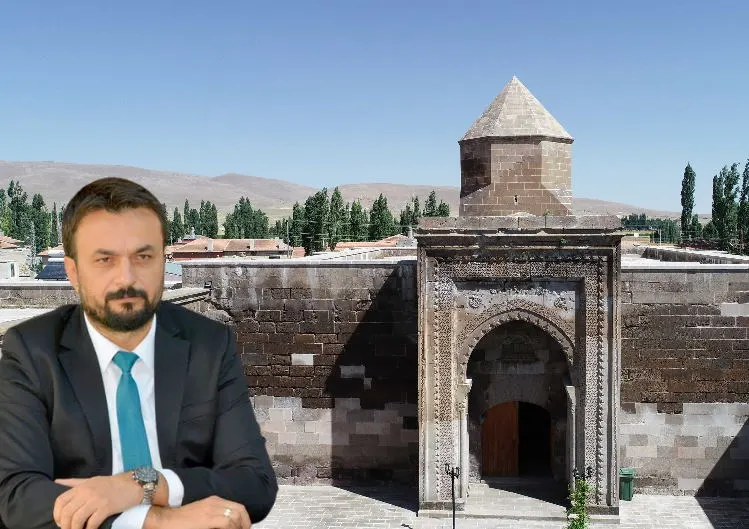
An accommodation and trade center from the anatolian Seljuks period: Karatay han
4 min read
PhD. Şükrü DURSUN
Kayseri Provincial Deputy Director of Culture and Tourism
Kayseri was one of the most important trade centers of the Anatolian Seljuks with its location where international and inter-regional roads connecting east-west, north-south pass. The Seljuks built caravanserais on these roads, which constitute a part of the Silk Road, enabling caravans and passengers to accommodate and meet their various needs, and also took many precautions for the caravans to travel safely on the roads. Among these, Karatay Han, which was built by Emir Celaleddin Karatay, one of the important statesmen of the Anatolian Seljuk period, in the Bünyan District of Kayseri, Karatay (Karadayı) District, is one of the most monumental examples of its period.
Kerîmüddîn Mahmud-i Aksarayî, the famous author of the Seljuk period; stated the following important information about Emir Celaleddin Karatay and the caravanserai he built in Kayseri:
“When the ribat (caravanserai) he had built in Zamantı on the Elbistan road was completed, he departed from Kayseri to see it. When he approached it he came back with regret. While doing this, he thought that when he saw that big building, he would feel arrogance, and he would retreat from his good deeds with that arrogance. Although he had this magnificent building built from the beginning to the end, he did not see it. When they brought the account and expense book of the building to him, they saw that there was a lot of money left from the expenditure made there, and upon his order, they burned all the documents. Because he did not want trustees, workers, masters and salary holders to be distressed and seen as debtors because of the balance.”
Karatay Han, which lies in the north-south direction, consists of a courtyard in the south and a closed (shelter) part in the north. As it is learned from the inscriptions, its construction started in the 1st Alaeddin Keykubad period and was completed in the 2nd Gıyaseddin Keyhüsrev period in H.638 / 1240-41.
The inn, built with volcanic smooth cut stone, which is widely used in Kayseri, has very thick and high walls supported by buttresses.
The courtyard part is larger than the closed part. This section is entered through the crown door in the middle of the south facade, first to the entrance iwan and then to the wide courtyard. There is a room to the west of the iwan, a vaulted corridor and fountain iwan that provides access to the southwestern spaces, and a different place in the east wing. Apart from these sections, the courtyard is surrounded by a mosque in the east of the entrance iwan, the door of which opens to the north, the bath that covers the entire southeast corner, rooms lined up in the east, and double porticoes in the west. Some of the rooms are reserved for the use of staff for the services provided in the inn, and some are for the accommodation of passengers. In the courtyard part, the main accommodation place of the passengers is the portico section in the west wing of the courtyard. At the same time, this section is one of the areas where merchants shop among themselves.
The closed section in the north of the courtyard is a very large place where passengers sleep with their animals, especially in winter. This section, which is entered through the crown door, which is more modest in size than the courtyard crown gate in the south, consists of a middle nave extending in the north-south direction in the middle and seven naves in the east-west direction connected perpendicular to the middle aisle on the sides. The middle aisle, which is covered with a pointed vault, is kept higher than the side aisles and a lighthouse is placed in the middle. Here, there are benches where the residents unload their goods and rest. The areas other than the benches are the sections where the passengers tie their animals.
In addition to its architectural features, Karatay Han is quite remarkable with its uniquely beautiful decorations. Various types of geometric, vegetal, figural, objective and structural elements are used in the decorations that are distributed in different parts of the building. Among these, fifteen different figures lined up one after the other in the upper belt on the entrance facade of the fountain iwan and the arch facing the courtyard of the entrance iwan and two opposite dragon figures with knotted bodies on the surface are among the prominent decorations.
The building is also of particular importance with its endowment, which contains the most detailed information from the Seljuk period to the present day. Although this foundation gives information about the functioning of Karatay Han, it is also of great value to reveal the quality of Seljuk caravanserais in general.